Note to Liberals: Obeying The Constitution Can Not Destroy It
A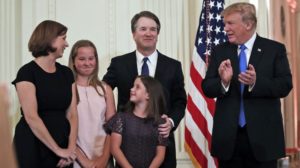 s usual, the liberal media either fail to understand or deliberately distort the debate over judicial philosophy.
On June 27 Supreme Court Justice Anthony Kennedy announced his retirement. After one or two minutes of review of Justice Kennedy’s thirty years on the Court, the thundering media herd immediately stampeded to wild, hysterical speculation about future court rulings after President Trump appointed a replacement who would, presumably, be confirmed by the GOP Senate majority.
 We were regaled by dozens of apocalyptic predictions on cable news. Typical was Senator Kamala Harris of California who told MSNBC’s Chris Matthews.
We’re looking at a destruction of the Constitution of the United States as far as I can tell.
Twelve days later the President selected Judge Brett Kavanaugh and the rage continues.
Trump’s political operations are often clumsy. But his Supreme Court nomination strategy is inspired. He published The List of pre-approved candidates during the 2016 campaign and added a few names last year. Thus, he guaranteed in advance to concerned Republican voters that whatever their reservations about his temperament, demeanor, personal morality, or history of flirting with liberalism, they would be thrilled with his Supreme Court choices. He confirmed that guarantee with his first Supreme Court appointment from The List, Neil Gorsuch.
The establishment media are wrong to characterize the philosophical battle over Supreme Court appointments as merely an extension of America’s standard, liberal vs conservative political divide. The “liberal” label is appropriate for one side. But “conservative” is an imprecise, even misleading label. Each candidate on The List has been a judge whose decisions and opinions were thoroughly examined and certified to be not “conservative” but of the “originalist” or “textualist” school of thought.
An earlier version of originalist thinking, called “original intent,” claimed allegiance to the “intent of the founders” who wrote the Constitution. But this included inferring intent from sources outside the Constitution, such as essays and speeches by various founders or even by people who didn’t participate in drafting the Constituiton. Inevitably, conflicting versions of intent arose. Thus “textualism,” the theory that the text they wrote was the best window into the founders’ intent is now the guiding philosophy of Constitutional interpretation of all the judges on The List.
Liberals/progressives, on the other hand, believe Supreme Court Justices should use the power of the court to enforce liberal doctrines and help groups that liberals favor, even if the resulting rulings conflict with the text of the Constitution or laws enacted by Congress. They often tell us judges should be guided by ambiguous, emotional considerations such as “empathy” or “inclusion.” The Liberal goal is for the court to issue rulings that force all of us into compliance with their continuously evolving ideas and positions.
Thus, the real debate is originalist or textual interpretation vs liberal interpretation, NOT conservative vs liberal.
A Justice who practices textual interpretation can find him/herself ruling against litigants with whom he/she sympathizes and even against his/her personal beliefs. On the other hand, a judge who practices the liberal school of thought will nearly always contrive some pretext to rule in favor of sympathetic litigants or personal beliefs, regardless of the law or the Constitution.
It turns out that the last Supreme Court decision of the 2017-18 docket, Janus Vs American Federation of State, County, and Municipal Employees (a public employee union) published June 27, just hours before Kennedy announced his retirement, is a textbook example of originalist/textualist interpretation Vs liberal interpretation.
Mr. Janus is an employee of the State of Illinois. State law forced him to pay fees, automatically deducted from his paychecks, to the union that represents all the employees in his department, even though he is not, and does not want to be a union member. His lawsuit asserted that this requirement is Unconstitutional because it violates his First Amendment right to freedom of speech by forcing him to financially support the union’s political speech, its donations to candidates, and its lobbying for legislation, all of which he opposes.
The State’s position was that requiring an employee to pay the fees had been found to be Constitutional in a 1977 Supreme Court Decision, Abood Vs Detroit Board of Education. In a lengthy, carefully reasoned opinion the Court’s majority found, based on textualist interpretation that the state did indeed infringe on Janus’s freedom of speech by forcing him to pay for the speech of others. The Court ruled in his favor by overturning Abood and replacing it with a new ruling that forbids states and unions from forcing non-member employees to pay fees.
The Court’s liberal minority wrote a dissenting opinion setting forth their position. They tacitly agreed that the payment scheme did infringe on an employee’s freedom of speech. But, they asserted, this infringement should be allowed, in spite of the plain text of the Constitution because it “struck a balance” between an employee’s First amendment rights and the state government’s interests in “running their workforces as they thought proper.” The minority Justices went on to list what they considered negative consequences of ruling that States could no longer force non-members to pay unions as a condition of employment, including:
- “Public employee unions will lose a secure source of financial support.”
- “State and local governments…will need to find new ways of managing their work-forces”
- Forcing non-members to pay the fees “has proved workable” and “is deeply entrenched.”
- “…the relationships of public employees and their employers will alter in both predictable and wholly unexpected ways.”
In other words, the State of Illinois should be allowed to continue to violate the United States Constitution! Why? Because the union needs money! Oh, and because the state and the union had an “entrenched” and “workable” relationship and now they’ll have to make changes.
Obviously, if a court’s ruling is based on the text of the Constitution, that an American’s freedom of speech may not be infringed by government, these considerations are not relevant. The whole point of the First Amendment is to forbid government from infringing upon our rights, no matter what the justification! Yet these Supreme Court liberals would simply disregard the Constitution to support a union, because unions promote liberal positions and liberal candidates.
This minority opinion, is a perfect example of liberal interpretation, holding that their personal preferences, not the Constitution, should be the Supreme Law of the Land!
Over the coming weeks and months we will endure endless, doomsday predictions of great harm to the nation if Judge Kavanaugh is seated on the Supreme Court. Most preposterous of all are predictions like the one by Senator Harris quoted above that the Constitution will be destroyed if the Court complies with it rather than what she supports, simply ignoring what it says!
