The Deficit Can Not Be Closed With Tax Increases
UPDATE: Administration official David Pluffe, appearing on Fox News Sunday announced that this week the President would present “a plan” for deficit reduction that would include raising the top two income tax brackets to the pre-Bush rates.
Congress and the President are beginning what will become an historic two-year debate over the cost and appropriate role of government. Spending has increased so much in the past two years that in 2011 the government will have to borrow 43¢ of every dollar it spends, compared to 15¢ in 2008 and 6¢ in 2007. But Democrats are unwilling to cut anything.
An emerging Democrat-media budget deception is about “tax breaks for the rich,” enacted under President Bush in 2003. Even before he was elected President Obama announced his intention to raise the top two bracket rates to from 33% and 35% to the pre-Bush rates of 35% and 39.6%. But so far, he has been unable to convince Congress to enact the increases.
The Democratic-Media talking point we’ve heard this week is that if “the wealthy paid their fair share”- meaning the pre-Bush rates – “we could afford” Obama’s massive increase in the cost of government.
So, we ran a “what-if.” As the chart below shows increasing tax rates on the rich to the pre-Bush rates, or even doubling them to 66% and 70% would not make a significant dent in the astronomical deficit.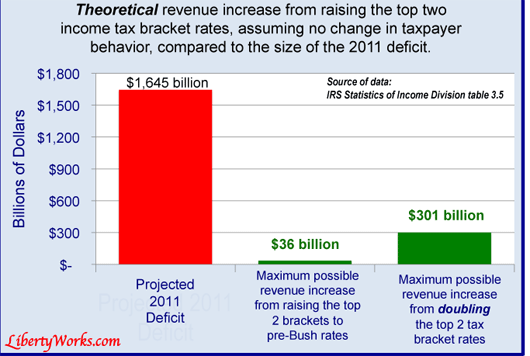
The most recent data available from the IRS is from 2008. The green column in the middle shows that $36 billion in additional revenue would be collected if the top two brackets had been raised to the pre-Bush rates. The green column on the right shows how much additional revenue be collected if the top two brackets were doubled to 66% and 70%.
Obviously, these tax rate increases would not have raised nearly enough revenue to offset the enormous deficit the Obama Administration is planning for 2011. But even the small increases in revenue shown in the chart are too optimistic because they don’t take into account the historically demonstrated fact that as tax bracket rates go up taxable income goes down.
High income people have the ability to defer part of their income to future years or to hire lawyers and accounts to devise exotic ways to shelter income, or to simply quit working before the end of the year if they decide the tax burden on additional income will be too great. Thus, there would be less taxable income if the rates were higher and the additional revenue amounts shown in the chart are more than would actually be collected.
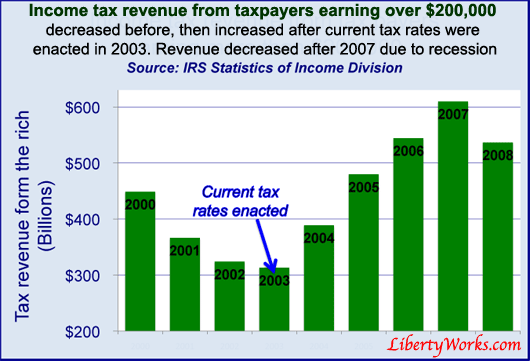
As the chart below shows tax revenue was falling before the Bush tax cuts of 2003 and the government collected more tax revenue from the rich after the tax rates were reduced.
Cost born by the middle class
Not only would pre-Bush tax rates fail to raise nearly enough revenue to balance the budget, there would be a cost to the economy and to the middle class in the form of fewer business start-ups and expansions and fewer new jobs created. Half the taxpayers in the upper brackets are small business owners. Most small business expansion and job creation is funded from after tax profits. Higher tax rates mean less in after tax profits and thus, fewer new jobs.

Sir,
One could easily argue that tax revenues decreased during the period shown due to the recession during that period.
I’m not pro-tax. Don’t get me wrong. But I’m not convinced that cutting taxes ALWAYS ends up in greater revenue. (Which is essentially the tea party line).
It’s a strong argument to be sure that lower taxes means greater investment. But the argument that it also increases government revenue falls pretty short. The size of this deficit will require great cuts in spending, but it will also realistically require increases in taxation.
Are higher taxes good for the economy? No. But taxes need to be sufficient to cover government expenses. And right now, there is no way to cut spending to the extent that it needs to be cut without also severely impacting the economy.
Anon –
The issue there of course is “where are we on the Laffer curve?” That is an unknowable, and I strongly suspect that the apex is not static and changes over time with general stste of the economy. I have seen alot of commentary that we are about at the apex right now. Remember, the public equity and housing markets have wiped out alot of wealth. In my business, private equity, I can tell you from first hand experience that tax increases will result in slack growth – meaning slack investment, slack employment and slack tax revenues. My slice of the world may not be representative of the entire economy – again, its an unknowable – but I happen to think it is. Small business is where job growth occurs.
Boomer –
Every single analysis I’ve seen shows that at both the federal and state/local level the mushrooming health care and pension costs absolutely dwarf the ability for any imaginable tax increses to fund them. It speaks to your point: tax increases of a magnitude to actuarily pay for spending would choke the economy to the point of death. And its economic growth that produces the big tax dollars, not rates.
This absurd belief that we can’t annoy the rich with slightly higher tax rates is wearing thin. We the people see through it and we are fed up.
I don’t really care if a health insurance CEO or bank barron can’t afford an a second yacht. The rich are having a party while the middle class is getting strangled. What happened to shared sacrifice?
Obama wants the same taxes that were in effect during the 90s when the economy was booming, jobs were at record highs and the government ran a surplus.
How bad would that be? Is this better?
BigSky –
Perhaps you would like to take a high school class in arithmetic. First, look at the financing requirement of entitlements. Second, look at the advertised tax take from rate increases. Compare.
Then consider that the advertised increases in tax rates might not produce what is advertised. What a mess.
Get real.